

Ontario tenant screening checklist
Tenant Screening Checklist for Ontario Landlords
Short answer: An Ontario tenant screening checklist should begin with one written, lawful policy applied consistently to every applicant. Confirm the rental and criteria, provide required information, obtain meaningful consent before collecting or checking personal data, verify identity and ability to meet rent through proportionate evidence, contact references consistently, avoid protected-ground discrimination, secure records, document the decision and dispose of data appropriately.
Screening is not a search for a perfect tenant. It is a controlled housing decision with human-rights and privacy consequences. Informal shortcuts, social-media searches and different questions for different applicants can create unfairness and poor evidence.
Fastcan Property Management publishes residential and rental services. This checklist is general education, not legal advice or a claim about the firm’s current screening process.

Checklist 1 defines the rental and lawful policy
Write the unit, rent, included services, occupancy date and criteria before reviewing applicants. Use criteria tied to tenancy obligations, not stereotypes. The Ontario Human Rights Commission publishes a policy on human rights and rental housing.
Obtain legal advice on current Ontario requirements and accommodation duties.
Checklist 2 gives notice and obtains consent
Tell applicants what information is collected, why, who receives it, which checks are conducted, how long it is retained and how questions can be raised. Obtain valid consent before contacting references or obtaining consumer reports where required.
Do not collect a SIN, bank login, passport image or other sensitive data merely because it is convenient.
Checklist 3 verifies proportionate evidence consistently
Use the same identity, income or ability-to-pay, reference and credit approach for comparable applicants. Consider lawful alternatives when a standard document is unavailable. Verify documents through appropriate routes without accusing an applicant based on appearance.
The Office of the Privacy Commissioner of Canada publishes privacy information for landlords and tenants.
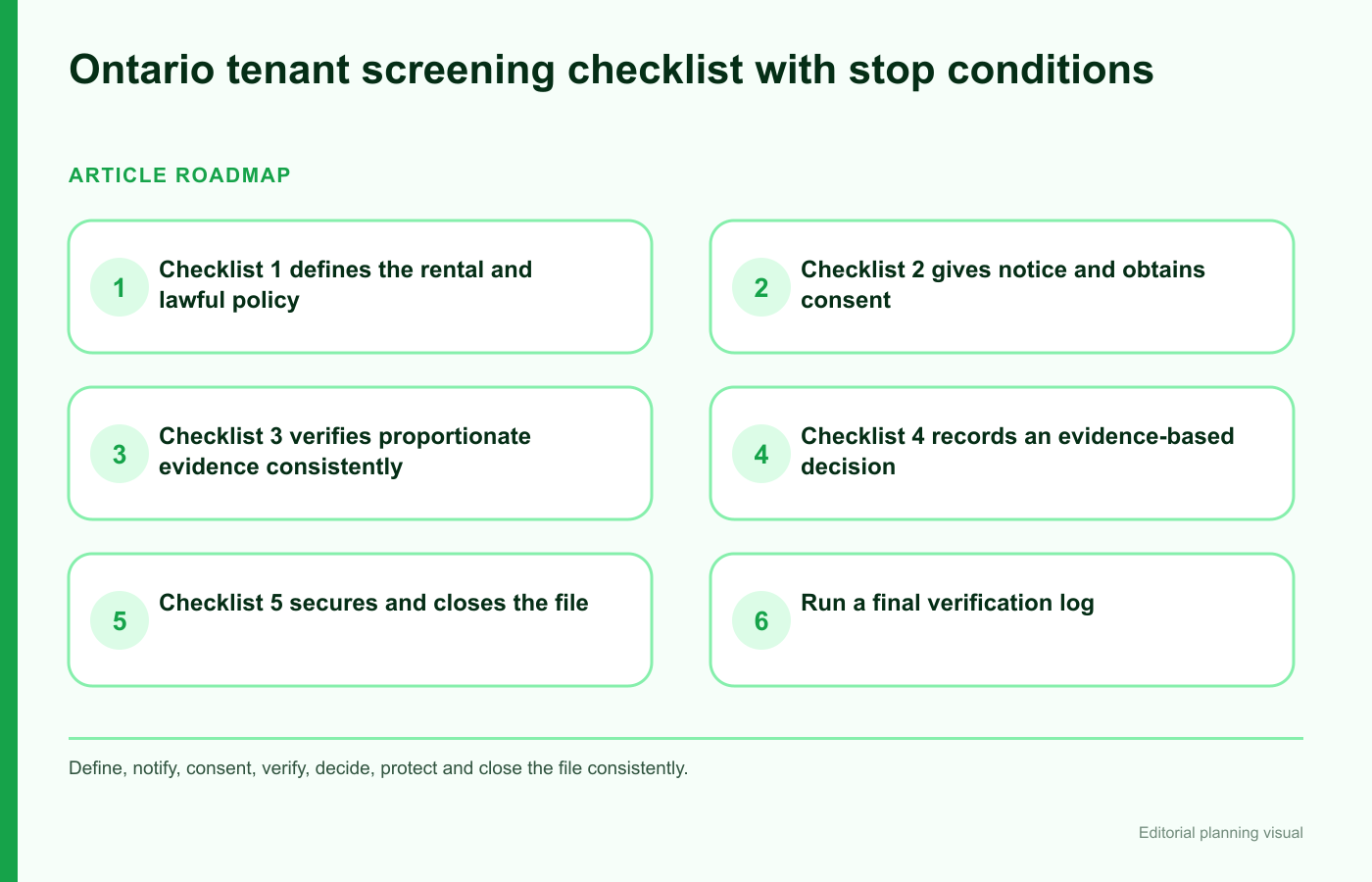
Checklist 4 records an evidence-based decision
Use a decision sheet that separates verified facts, unresolved items and the outcome. Apply published tie-breaking or sequencing rules consistently. Do not use protected characteristics, family stereotypes, source of income stereotypes or irrelevant online information.
Pause when criteria have changed mid-process or comparable applicants are treated differently.
Checklist 5 secures and closes the file
Limit access, use secure storage, record disclosures, correct errors and retain only as long as a lawful business purpose requires. Dispose of rejected-applicant information securely. Review Fastcan’s privacy policy and confirm actual practices.
Use its residential service page and contact route for current management scope.
Run a final verification log
Before acting on ontario tenant screening checklist, create a dated log with four columns: material question, source checked, answer received and status. Use confirmed, unresolved or changed rather than forcing every row into yes or no. Reopen time-sensitive pages close to the decision and compare the current information with the saved version. When a phone answer controls cost, safety, access, eligibility, timing or scope, send a written summary to the responsible contact and invite correction.
Close the log only after every unresolved item has an owner, a deadline and a stop rule. If the provider, professional, platform or authority cannot confirm a consequential point, change the plan, narrow the commitment or obtain appropriate independent review. Keep the log with confirmations, receipts, instructions and later changes so that a substitution, delay, dispute, symptom or policy update can be assessed against the evidence actually used.
Compare evidence, not labels
Turn tenant screening checklist into a written decision. State the outcome, who is affected, required location or jurisdiction, timing, budget or resource boundary, and any health, safety, legal, privacy, accessibility, cultural or technical constraint. Then compare each option against the same evidence. A familiar label, attractive image, high rating or confident sales statement is not a substitute for current scope and terms.
| Decision check | Evidence to collect | Reason to pause |
|---|---|---|
| Identity | Exact business, provider, product, location or responsible party | Names, addresses or records conflict |
| Scope | Included work, exclusions and dependencies | A material step is only implied |
| Authority | Current first-party and official source | Status cannot be independently checked |
| Risk | Warnings, alternatives and escalation route | Qualified review is needed |
| Terms | Total commitment, timing, changes and cancellation | Important terms remain verbal or open-ended |
Use the comparison to remove unsuitable options, not to manufacture a universal winner. Reader fit, operating conditions and consequences can change the best next step.
Cross-check current sources
Start with Fastcan Property Management’s current page for what the business publishes, then check this primary or authoritative source and this second authoritative source for the rules or evidence they control. External guidance does not verify this business, and a business page cannot override a regulator, platform owner, medical body, government or standards organization.
Save the URL, access date, exact statement and any uncertainty. Separate a general rule from a case-specific approval. When the decision involves diagnosis, surgery, lending, tenancy rights, structural safety, religious interpretation, travel entry or another high-consequence issue, use an appropriately qualified professional rather than filling gaps with inference.
Use a controlled action sequence
- Write the decision, required outcome and non-negotiable constraints.
- Verify the exact provider, location, item, platform or professional.
- Collect current first-party details and authoritative rules.
- Send the same unresolved questions to each relevant option.
- Compare complete scope, exclusions, risks, terms and alternatives.
- Escalate unresolved high-stakes questions before commitment.
- Approve only the bounded next step and retain the record.
Set a stop condition before payment, travel, treatment, installation, borrowing, tenant selection, food service or account access. Examples include an unverified identity, contradictory document, unsafe symptom, missing allergen answer, unclear fee, changed address, unsupported performance claim or request to bypass a platform or legal rule.
Create a decision-ready handoff
Prepare a one-page handoff containing the objective, verified facts, open questions, source links, responsible contact and next deadline. Mark assumptions visibly and say what evidence would confirm or reject each one. This prevents a polished summary, generated illustration or confident claim from being treated as proof.
Name the escalation route and keep dated versions when facts change. Later reviewers should be able to see who confirmed each material point, which document controlled, why the decision changed and what remains unverified. A clear record does not guarantee an outcome, but it reduces ambiguity and supports faster correction.
Common mistakes to avoid
- Changing criteria after seeing applicants
- Using protected characteristics or stereotypes
- Collecting excessive identity or banking data
- Checking references without proper consent
- Applying income or credit rules inconsistently
- Using informal social-media searches
- Rejecting an applicant on an unverified discrepancy
- Keeping applicant data indefinitely
- Treating a property manager’s process as legal advice
Frequently asked questions
Can a landlord use the same checklist for every unit?
Use a consistent lawful framework, while unit facts and accommodation duties may require documented case-specific handling.
Should a landlord ask for a SIN?
Do not collect sensitive identifiers by default. Obtain current privacy and legal advice on what is necessary for a specific check.
Can social media be used for screening?
It creates relevance, accuracy, consent and discrimination risks. Use proportionate, lawful sources and obtain legal advice.
What if an applicant disputes a record?
Pause the decision where appropriate, identify the source and provide a fair route to correct or explain material information.
Take the next step with Fastcan Property Management
Review Fastcan Property Management’s residential service and privacy policy, then use its contact page to request the current tenant-placement scope, consent flow, criteria, data handling and decision records. Obtain Ontario legal advice before deployment.
General educational information only. Confirm current business details, eligibility, professional advice, law, health and safety needs before publication or action.